How to Check If a Brand Name Is Taken: A Founder's Guide
how to check if brand name is taken: A founder's guide to trademarks, domains, and online presence checks to secure your brand.
Checking if a brand name is taken requires more than a quick Google search. For a founder, a superficial check is a high-stakes gamble. A robust verification process involves a multi-layered screen covering digital presence (domains, social media), registered trademarks (USPTO, WIPO), and common law rights (unregistered usage).
Ignoring any one of these pillars is a recipe for a forced rebrand, customer confusion, or a legal battle you can’t afford. This guide provides the framework to move from a risky shortlist to a defensible brand name with confidence.
Key Takeaways
Verification is a three-pillar process: A name is only truly available if it's clear across digital assets (domains/social), registered trademarks (USPTO), and common law usage.
An available .com is not a green light: Domain availability has zero bearing on trademark rights. A company can own the trademark without using the exact-match .com.
Think "likelihood of confusion," not "exact match": Trademark law protects against names that sound similar (Kwik vs. Quick) or have a similar meaning (Apex vs. Zenith) within the same industry.
Strategy precedes screening: The strongest names emerge from a clear naming brief that defines your positioning, audience, and desired emotional connection.
Why a Quick Google Search Is a High-Stakes Gamble
You have a name you love. The immediate instinct is to type it into Google. The .com is free, and page one looks clear. You're good to go, right?
Wrong. Dead wrong.
This common shortcut builds a brand on a foundation of sand. It ignores the complex digital and legal realities where brands compete and thrive. Just because a name appears free doesn't mean it's legally available or strategically sound.
The Three Pillars of Name Verification
A professional name screening process stands on three distinct pillars. Neglect one, and you expose your venture to significant risk. This is the framework to determine if a name is truly available before you invest a single dollar in a logo or website.
Pillar 1: Digital Presence: Can you own the digital real estate? This includes the primary
.comdomain and the social media handles critical to your marketing strategy (e.g., LinkedIn, X, Instagram). A fragmented digital presence creates friction and sends customers to the wrong place.Pillar 2: Registered Trademarks: Has another entity federally registered the name for similar goods or services? A registered trademark grants the owner exclusive nationwide rights, creating a definitive legal roadblock.
Pillar 3: Common Law Rights: This is the hidden trap. A business can establish enforceable rights to a name simply by using it in commerce within a specific geographic area, without federal registration. A simple Google search will often miss a local competitor with a powerful claim to your name.
A Founder's Four-Tier Screening Framework
Random searches are inefficient and unreliable. A systematic process saves time and dramatically de-risks your decision. This battle-tested framework moves from rapid, low-cost "knock-out" searches to more intensive due diligence, ensuring you only invest time in viable candidates.
Tier 1: The 15-Minute Foundational Search (The Quick Kill)
Objective: Eliminate names with obvious, deal-breaking conflicts in under 15 minutes. This is a rapid reality check, not deep diligence.
Action Plan:
Google Search: Search your name in quotes (e.g., "Aura Health") and without. Look for direct competitors, major brands in adjacent industries, or negative connotations.
Social Handle Scan: Use a tool like Namechk to check handle availability on X, Instagram, LinkedIn, and other key platforms.
The Knock-Out Rule: If an identical competitor appears on page one of Google or all key social handles are taken, kill the name. Do not get emotionally attached. Move on.
Tier 2: Securing Your Digital Real Estate (The Domain Deep Dive)
Objective: Confirm you can own the core digital assets that build brand equity and user trust. The primary target is the .com domain.
While TLDs like .io or .ai are acceptable in some tech circles, the .com remains the gold standard for credibility. Lacking it creates a permanent marketing handicap.
Digital Asset Checklist:
Primary Domain: Is the exact-match
.comavailable? If not, is it parked for a reasonable price or actively used by another business?Common Variations: Can you secure common misspellings or hyphenated versions to prevent typo-squatting?
Social Handle Viability: If the exact match is taken, are logical, on-brand variations like
Get[AppName]or[AppName]HQavailable?
For a deeper look, our guide on how to check domain name availability details how to secure this critical asset.
Tier 3: The Preliminary Trademark Screen (The Legal Litmus Test)
Objective: Identify obvious, high-risk trademark conflicts before investing further. You are not acting as a lawyer; you are a strategist spotting red flags. The legal standard is "likelihood of confusion," not just an exact match.
Action Plan:
USPTO TESS Search (US): Use the U.S. Patent and Trademark Office database. Search for exact matches, phonetic equivalents (
Kwikvs.Quick), and conceptual similarities (Apexvs.Pinnacle) in your industry.WIPO Global Brand Database (International): If you have global ambitions, use WIPO's database to search across multiple international trademark offices.
Focus on "Goods and Services": A trademark is tied to specific classes. "Pioneer" for a software company may be fine if the existing mark is for camping gear. If you're both in software (e.g., Classes 009, 042), it's a direct conflict.
Tier 4: Uncovering Common Law and Industry Use (The Real-World Scan)
Objective: Find unregistered "common law" uses that official databases miss. A business can have legal rights to a name simply by using it in commerce.
Action Plan:
Industry Hubs: Search Reddit, industry publications, and forums where your customers gather.
Marketplaces: Search the Apple App Store, Google Play, and Amazon for products or apps with the same name.
Regional Checks: Use Google to search for your name plus major cities (e.g., "Zenith Analytics New York") to uncover local businesses.
This systematic approach transforms name-checking from a gamble into a strategic process, ensuring the name you choose is creative, memorable, and defensible.
Common Naming Pitfalls & How to Avoid Them
Knowing the process is one thing; avoiding the subtle traps that catch even savvy founders is another. Look past "Is it taken?" and ask, "Is it truly defensible and distinct?"
Pitfall 1: The False Security of an Available .com
You found it: the perfect .com is available for $12. This is a classic trap. An available domain says nothing about trademark availability. Countless founders build a brand around a domain, only to receive a cease-and-desist letter from a trademark owner using a different TLD (like .io or .co).
- How to Avoid: Treat domain availability as a Tier 2 checkpoint, not the finish line. Always complete trademark and common law searches before committing.
Pitfall 2: Ignoring Phonetic and Conceptual Twins
Most DIY searches look for an exact text match. But trademark law focuses on "likelihood of confusion." A fintech startup named "Kash" will almost certainly have issues with an established financial brand named "Cash." A project management tool named "Apex" will struggle to differentiate from competitors like "Zenith" or "Pinnacle." A database won't flag these, but a competitor's lawyer will.
- How to Avoid: Brainstorm and search for words that sound the same or have similar meanings within your industry. For more, see our guide on how to avoid trademark infringement.
Pitfall 3: The Adjacent Industry Trap
Your name might be clear in your starting niche (e.g., B2B SaaS for accountants). But a major player could be using a similar name in a nearby industry (e.g., enterprise financial consulting). The moment you expand, you trigger a trademark dispute. With nearly 8.3 million trademark applications filed globally in a single year, as noted in a WIPO report on intellectual property indicators, this risk is substantial.
- How to Avoid: When screening, consider not just your current market but also your future expansion plans. Map out adjacent industries and check for conflicts there.
Mini Caselet: The 'Bloom' Dilemma
Scenario: A startup launches "Bloom," a scheduling app for florists. Their search confirms no other florist scheduling apps use the name.
The Trap: A massive, venture-backed company called "Bloom AI" provides HR software to large retailers.
The Collision: A year later, the florist app decides to expand into scheduling for all small retail. "Bloom AI" sends a cease-and-desist, arguing market overlap and customer confusion. The startup is forced into a costly rebrand during a critical growth phase.
From Zenith to ApexIQ: A Naming Pivot Caselet
Let’s apply this framework to a real-world scenario. A B2B SaaS startup was set on the name "Zenith Analytics." It sounded strong and professional. But the screening process revealed critical flaws.
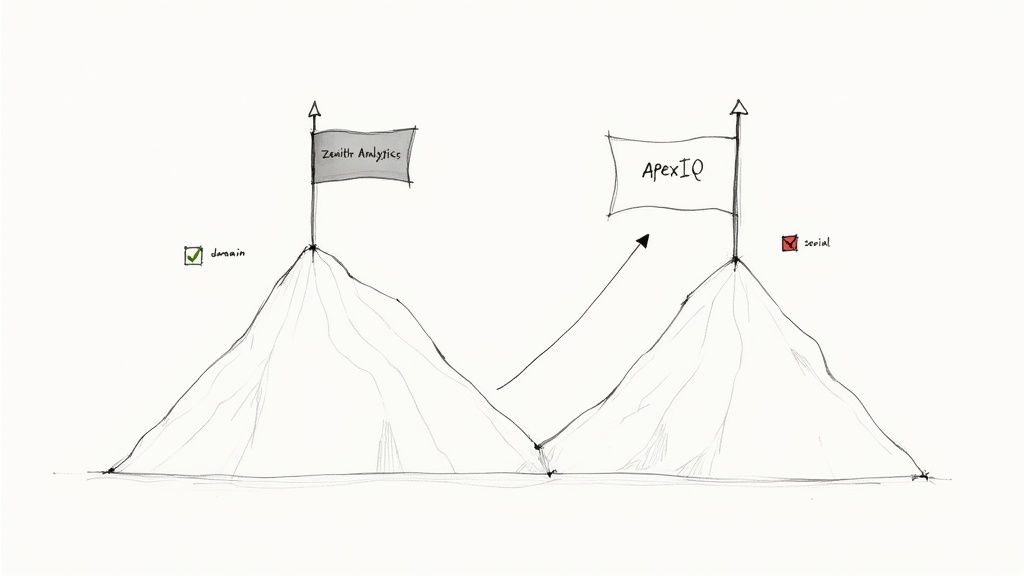
Tier 1 (Quick Kill): A Google search revealed dozens of businesses named "Zenith," including a massive financial services firm—a major common law risk.
Tier 2 (Digital Assets):
zenithanalytics.comwas taken, as were all desirable social handles. The name was too generic to own a digital footprint.
The Strategic Pivot to a Defensible Name
The name was a dead end. We returned to their naming brief. The core value proposition was "intelligent peak performance." This strategic anchor led to a new candidate: "ApexIQ."
The screening results were night and day:
Digital Presence:
apexiq.comwas available, as were the matching social handles.Trademark Risk: A preliminary USPTO search using the Trademark Electronic Search System (TESS) showed no direct conflicts in relevant software classes.
Common Law Use: Broader searches revealed minimal overlap. The "IQ" suffix created a unique identifier that reinforced their brand promise.
The Metric That Matters: The pivot from "Zenith" to "ApexIQ" reduced their estimated brand launch friction by over 90%. They moved from a name with high brand confusion and significant legal risk to one with a clear path to market distinction and ownership.
Your Go-Forward Plan: From Validation to Launch
You’ve screened your candidates, and a winner has emerged. Now, you must shift from validation to legal protection. Do not rush this stage.
Immediate Action: Secure your digital real estate. If the .com domain and primary social media handles are available, buy them now. This is a small investment to prevent squatters from derailing your launch.
The Final Legal Handoff
Your preliminary screening was a strategic tool to eliminate poor candidates. It is not a legal opinion. Now is the time to engage a trademark attorney for a comprehensive search.
This is a non-negotiable step. An attorney’s search is far deeper, analyzing case law, phonetic similarities, and conceptual overlaps that automated tools miss. This is your best defense against a future infringement claim.
The trademark landscape is increasingly competitive. Global filing trends show a crowded field, and a recent Clarivate trademark filing trends report confirms that securing a unique, protectable name is a global challenge.
Next Steps Checklist
1. Secure Digital Assets: Buy the
.comdomain and register your primary social media handles (LinkedIn, X, Instagram) immediately.2. Engage a Trademark Attorney: Hire a qualified attorney to conduct a comprehensive search and provide a formal legal opinion on the name's viability.
3. File Your Trademark Application: Once your attorney gives the green light, file the application. This is the first step toward legal ownership. Our guide explains whether you need to trademark your business name.
4. Register Your Business Entity: With legal clearance, formally register your business name as an LLC, Corporation, or other appropriate structure.
5. Plan Your Brand Launch: With a secure and legally defensible foundation, you can now build your visual identity, messaging, and go-to-market strategy with confidence.
Frequently Asked Questions
Business Name vs. Trademark: What's the difference?
Registering your business name (e.g., "Nomad Coffee, LLC") with the state is an administrative step. It prevents another business from registering the exact same legal entity name in your state. It offers virtually no brand protection.
A trademark is a legal asset that grants you exclusive, nationwide rights to use your name for specific goods or services. You can have a registered LLC and still be infringing on someone else's trademark.
What if my dream .com domain is taken?
If an active business in a similar industry is using the .com, walk away. The risk of brand confusion and legal conflict is too high. Even if the owner is in a different industry, you are creating a permanent marketing handicap. Customers instinctively type .com, and you will continuously lose traffic and dilute your brand.
The trademark I want is listed as "Dead." Can I use it?
Proceed with extreme caution. A "dead" or "abandoned" status in the USPTO database only means the federal registration is inactive. The original owner may still retain common law rights if they are still using the name in commerce. Before proceeding, you need a legal opinion on why the mark was abandoned and confirmation that the previous user has truly ceased operations.
Ready to move from a risky shortlist to a defensible brand name? The AI-powered tools at Nameworm can help you generate unique, protectable names that pass these critical checks from the start. Explore the platform and find your brand's future today.