The Sound of a Name Is More Important Than the Meaning
Learn how to create a brand name that builds trust and recall. This guide covers the psychology of sound, practical strategies, and validation techniques.
When you encounter a brand name for the first time, your brain performs a fascinating act of subconscious triage. Before it processes what the name means, it reacts to how it sounds. This is the core insight of modern naming strategy: the phonetics of a name create an immediate, visceral emotional impression that shapes perception, trust, and memory far more powerfully than any literal definition. A name's sound creates the first feeling, and that feeling is often the only one that matters.
This isn't just marketing theory; it's a psycholinguistic reality. The brain's response to sound is primal, wired into our oldest neural pathways. Sound processing is an ancient, emotional function; semantic comprehension is a more recent, cognitive overlay. In the split-second world of brand discovery, emotion always arrives first. This auditory first impression becomes a subconscious filter, coloring every subsequent interaction with a brand. You can build a name’s meaning over time, but its sound creates an instant, irreversible gut reaction. You don’t get a second chance to make a first sound. If you want to evaluate how your name sounds—not just what it means—you can run it through Chat Nameworm.
The Brain Prefers Sound Over Semantics
To understand why sound trumps meaning, we have to look at how the mind is wired. Phonetic processing the act of hearing and interpreting sound is evolutionarily ancient. The ability to distinguish a gentle rustle from a sharp snap was a survival mechanism long before complex language existed. Sound connects directly to the limbic system, the brain's emotional core. Meaning, by contrast, requires cognitive heavy lifting by the newer, more analytical neocortex. In the race to make an impression, emotion always laps cognition.
This cognitive shortcut is explained by phenomena like affective priming, where a sound pre-loads an emotional response before the conscious mind can even begin to dissect a word’s definition. Your brain decides how it feels about a name long before it consciously connects it to a product. This is amplified by auditory fluency; the brain prefers sounds that are simple, rhythmic, and easy to process. A fluent name feels more familiar, trustworthy, and likable, even on first hearing.
The most compelling evidence for this is sound symbolism, often illustrated by the classic "bouba/kiki" effect. When people are shown two shapes—one rounded, one spiky—they overwhelmingly assign the nonsense name "bouba" to the soft, rounded shape and "kiki" to the sharp, spiky one. This holds true across cultures and languages, revealing a universal, hardwired link between sound shapes and perceived attributes. A name’s sound, therefore, can shape perceptions of trust, warmth, or dynamism before its dictionary meaning even has a chance to load.
Why Certain Sounds Feel Trustworthy, Energetic, or Soft
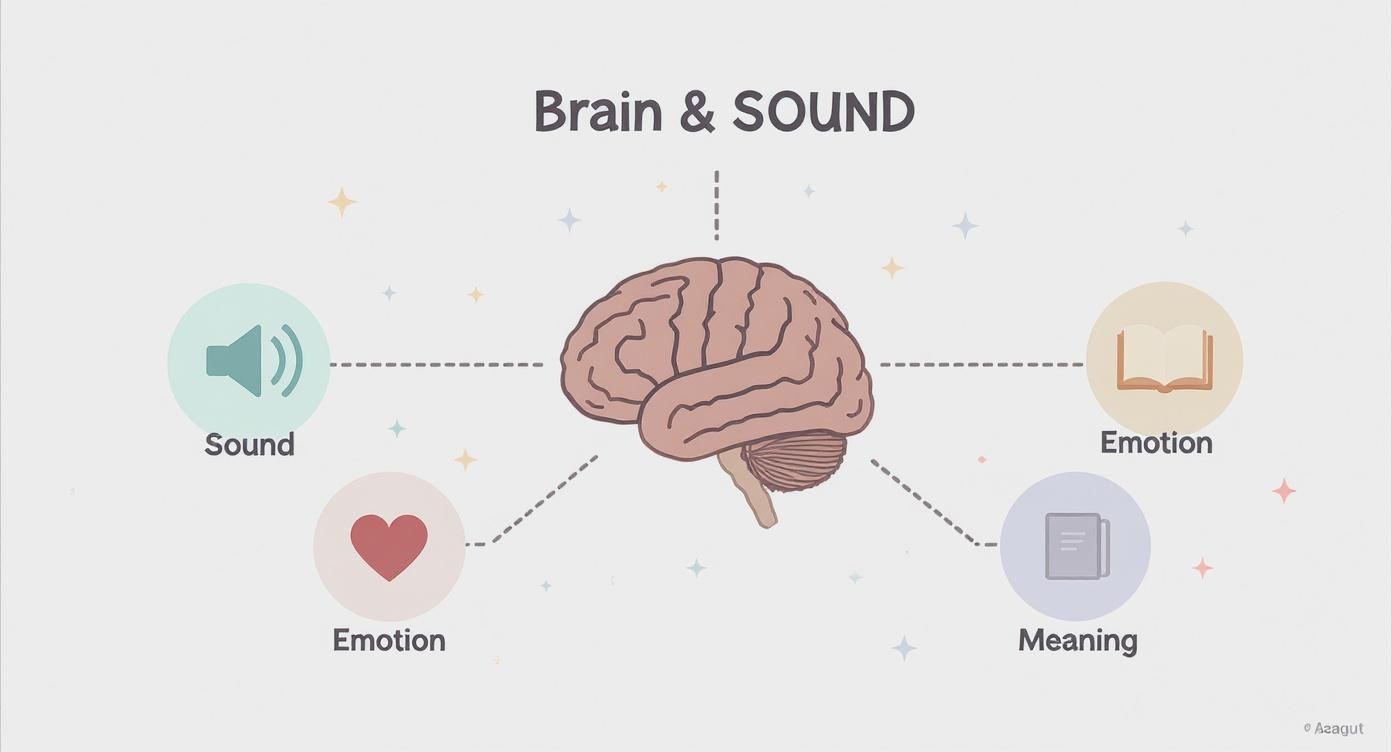
This intuitive link between sound and feeling allows us to engineer a brand’s personality directly into its name. Specific phonetic patterns send clear, subconscious signals. By choosing a name's acoustic properties, we are choosing its emotional DNA.
Soft consonants like L, M, N, and H are produced with minimal friction in the vocal tract. They are smooth, flowing sounds that evoke gentleness, warmth, and comfort. They feel human and approachable. Consider brands like Halo, Nori, and Luma. Their names feel soft on the tongue and soothing to the ear, creating an effortless sense of ease and well-being. These "liquid" sounds signal a brand that is comforting and humane.
Conversely, sharp consonants like K, T, and P—known as plosives—are created by a small burst of air. The resulting sound is crisp, energetic, and precise. This phonetic punch signals dynamism, efficiency, and boldness. Think of Lyft, with its sharp "ft" snap, or Klarna, with its clean, decisive "K". These names sound quick and modern, a perfect auditory match for brands built on speed and innovation.
The vowels in a name provide its melodic soul. Open vowels like 'a', 'o', and 'u' create a feeling of spaciousness, clarity, and modernity. They feel fresh and uncluttered. Brands like Lumos, Halo, and Nori leverage open vowels to feel welcoming and straightforward. The sound literally "opens up," inviting the customer in. A name can encode a brand’s entire personality through its sound signature alone. The choice between a soft 'L' and a sharp 'K' is not an aesthetic whim—it is a strategic decision that defines the first impression your brand will ever make.
Why People Remember Sounds Better Than Descriptions
A great brand name lodges itself in memory. This isn't luck; it's cognitive science. The brain is wired to remember sounds far more effectively than it remembers descriptive facts. This process is managed by the phonological loop, a component of working memory that acts as the brain’s internal sound system. Simple, rhythmic, and phonetically pleasing sounds are easier for this system to process, rehearse, and transfer to long-term memory. It’s the same reason a catchy melody gets stuck in your head for days, while a product’s feature list is forgotten in seconds.
Sound creates a powerful mnemonic shortcut. The name Lyft is memorable not because it has a literal meaning, but because its quick, airy sound feels fast, light, and playful. The name itself is an auditory experience. Similarly, Klarna sounds crisp, clean, and efficient. One hears it and gets an instinctive feel for its modern, Scandinavian vibe long before knowing it's a payments company. The sound does the heavy lifting, creating a mental hook for the brand’s essence.
This auditory advantage is crucial. A brand like Nori feels natural, minimal, and fresh—a perfect phonetic match for a brand in the modern food space. Lumos evokes light and clarity through its sound symbolism and open vowels; you don't need a Latin dictionary to get the vibe. These names win because their sound is their strategy. They are easy to say, pleasing to hear, and simple to remember, giving them an immediate cognitive edge. Meaning can be explained later. Sound must work instantly.
When Meaning Doesn’t Matter (Yet the Sound Wins)
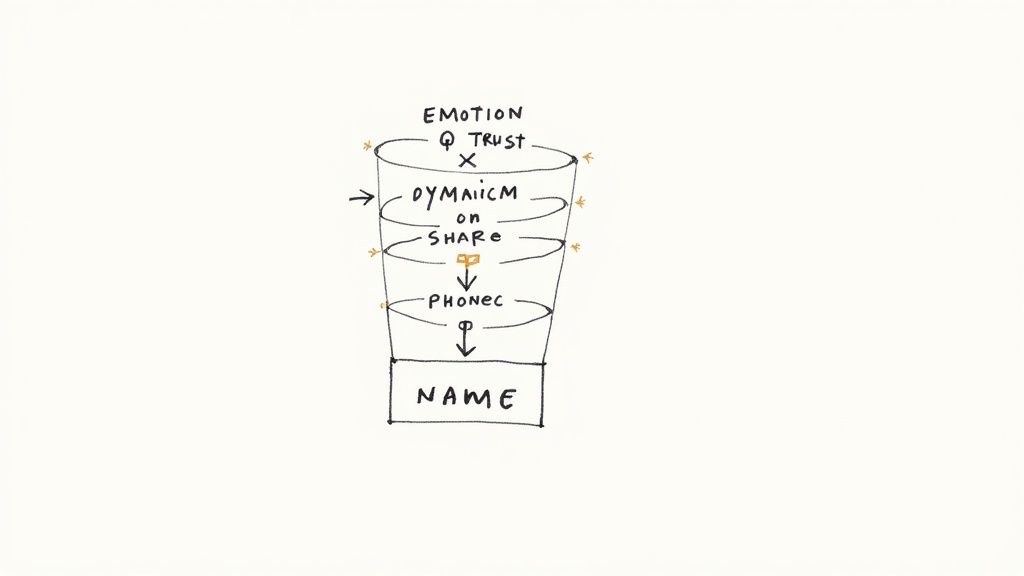
Many of today's most successful brands have names where the dictionary meaning is secondary, absent, or even irrelevant. Their success rests almost entirely on their phonetic power. They were built sound-first, trusting that emotional resonance would outperform literal description.
Consider the examples again. Lyft is an invented spelling, a phonetic gesture toward "lift" that prioritizes a feeling of speed and ease. Klarna is a Swedish construction meaning "clear" or "brighten," but its global success has nothing to do with translation; it works because it sounds sharp, modern, and trustworthy. Nori is a Japanese word for seaweed, but its use for a carbon removal marketplace succeeds because the sound feels natural, organic, and elemental. Lumos, derived from the Latin for "light," works not because people know its etymology, but because the sound itself feels illuminating.
In each case, the founders prioritized feeling over function. They understood a fundamental truth: customers don't Google the definition of a brand name—they decide how it feels in a fraction of a second. A name that sounds right creates an intuitive connection, bypassing the need for rational explanation. This sound-driven approach is a hallmark of sophisticated naming strategy, where the goal is not to describe but to evoke. The name becomes a vessel for meaning that is filled over time through brand experience, but the vessel's shape—its sound—is what makes it memorable and valuable in the first place.
How to Create a Name Where Sound Carries the Brand
To build a name on this principle, you must invert the typical creative process. Instead of starting with what your company does, you must start with how you want it to feel. The process becomes less about brainstorming descriptive words and more about composing an auditory identity.
First, identify the emotional core of your brand. Is it trust, dynamism, calm, or precision? This feeling is your strategic north star. Next, choose a phonetic palette that expresses that emotion. If your brand is about comfort and reliability, you'll gravitate toward soft consonants and liquid sounds (L, M, N). If it's about speed and innovation, you'll explore sharp plosives (K, T, P) and sibilants (S, Z) that create a sense of action and modernity.
This is the critical pivot: let sound shape the search for meaning, not the other way around. Prioritize auditory fluency, rhythm, and memorability over literal description. You are no longer just hunting for words; you are hunting for sounds that carry the right emotional weight. Avoid overfitting the name to a product feature that might change. The sound, and the feeling it creates, is what will endure. The right sound creates brand gravity—it pulls people in, allowing them to intuitively "get" the name without needing a lengthy explanation. It just feels right. This is the foundation of the process of naming your company for lasting impact.
Validate the Sound, Not Just the Word
Founders often check for an available domain and run a preliminary trademark screen, then stop. This is a critical error. A validation process that ignores phonetics is dangerously incomplete. A strong brand name check must stress-test a name’s auditory properties with the same rigor applied to its legal viability.
Your validation must go deeper, asking questions about the name's sound-shape. Does it have phonetic uniqueness, or does it blend into the auditory landscape of your competitors? Does it possess auditory memorability, sticking in the mind after being heard once? Can it withstand cross-language pronunciation without becoming awkward or taking on unintended meanings? And most importantly, does its emotional tone—the vibe carried by its sound—align with your brand strategy?
If you want to evaluate how your name sounds—not just what it means—you can run it through Chat Nameworm. It analyzes phonetics, semantics, vibe, emotional tone, competitive overlap, and early trademark risks, so you can see whether your name works at the level the brain actually responds to first. This ensures you're not just choosing a legally available word, but an emotionally resonant and strategically powerful asset.
Conclusion — In Branding, Sound Is Strategy
A name’s meaning can evolve. It can be built, shaped, and deepened over time through marketing, storytelling, and customer experience. But its sound is immediate, irreversible, and unforgettable. The first time someone hears your name, its phonetic impression is locked in, coloring every interaction that follows.
When you prioritize sound in your naming process, you build your brand on a foundation of pure intuition. You forge a subconscious connection that bypasses rational thought and creates an instinctive sense of trust and recognition. This is the strategic advantage held by founders who understand psycholinguistics. While others are trapped in the cycle of brainstorming descriptive keywords, you can focus on crafting an auditory identity that resonates emotionally and stands out phonetically. The lesson is simple:
Meaning is learned.
Sound is felt.
Name accordingly.