Why Strong Company Names Begin With an Emotional Intention, Not a Functional Description
Discover how to name your company by focusing on emotional connection, not just function. Learn why brands like Airbnb succeed with names that create a feeling.
Founders often start the naming process by chasing words that describe what their product does. This seems logical. Clear. Efficient. But it’s the first, most common mistake on the path to an enduring brand. The most resonant company names don’t begin with function; they emerge from a deeper layer: the emotional intention behind the brand—the feeling the company wants to create in the world.
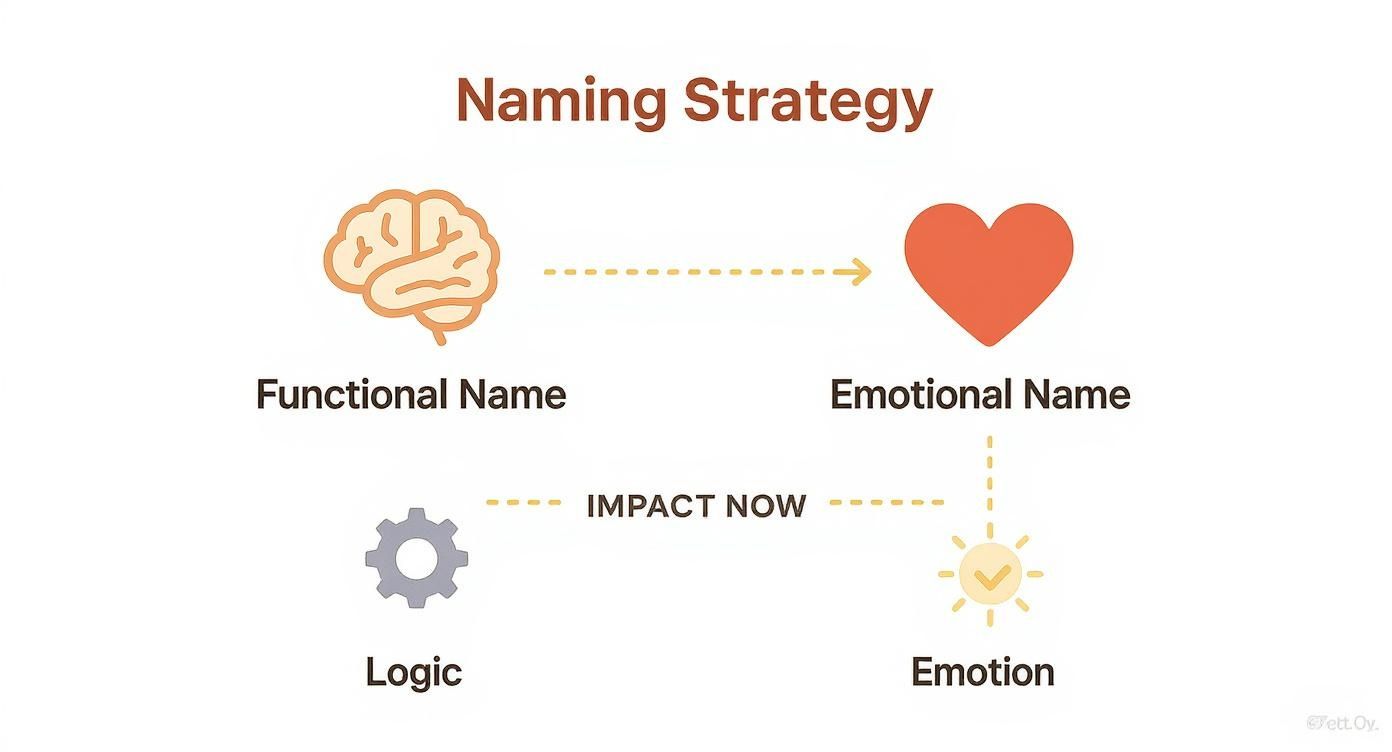
A functional name explains. An emotional name connects. One speaks to the analytical mind, which is slow and crowded. The other speaks to the heart, which is fast and intuitive. That connection, forged in feeling, is the bedrock of a brand that lasts. If you want to build a name that grows with you, you must begin not with a description, but with an emotion.
A Name Isn’t a Label. It’s a Feeling.
We are taught to label things, to describe them with accuracy. The impulse is natural: tell people what you do, clearly and directly. So we brainstorm words tied to our industry, our features, our value proposition. We hunt for a name that acts as a signpost, a functional summary of the business.
But this path, while seemingly efficient, misses the fundamental truth of how brands are built. A great name isn't a label. It’s a vessel for feeling. The world’s most resonant brands don’t describe what they sell; they evoke how you’ll feel when you engage with them. They begin with an emotional intention. They choose to stand for something deeper than a product category—a sense of clarity, a feeling of warmth, an aura of trust, or a rush of energy.
Emotion First, Words Second. Why This Matters
This shift from function to feeling is the single most crucial step in naming your company. It matters because emotions are faster than logic. People feel a brand long before they understand it, and that initial feeling colors every single interaction that follows.
A purely functional name speaks to the analytical part of the brain. The problem? The analytical brain is slow, skeptical, and demands proof. An emotional name, on the other hand, goes straight for the heart. That connection is instant, intuitive, and bypasses the rational gatekeepers. It creates an immediate sense of "I get this" or "this is for me."
When you anchor your name to a core emotional intention, you create a powerful thread that runs through every single touchpoint. Your logo, your website's color palette, the voice of your copy—it all starts to feel coherent and whole. This consistency builds trust on a subconscious level, making your brand feel authentic and memorable.
A functional name tells the mind what you do; an emotional name tells the heart why it matters. This distinction is the difference between a temporary solution and an enduring brand.
The Five Core Emotional Intentions Behind Modern Brands
To move from an abstract feeling to a concrete name, you first map the emotional territory your brand will own. Think of these emotions as strategic brand vectors—clear directions that guide your entire creative process. Nearly every powerful modern brand operates within one of five core emotional territories.
Clarity
Brands built on clarity promise to cut through complexity. They stand for transparency, simplicity, and a quieted mind. Their names often feel clean, open, and direct, using crisp phonetics and simple structures.
- Examples: Notion, Lumen, Drift.
Warmth
Warmth is about human connection and genuine care. These brands are rooted in comfort, compassion, and closeness, creating a sense of safety and belonging. Their names often have soft, rounded sounds and call to mind nurturing or communal ideas.
- Examples: Ritual, Maven, Haven.
Trust
Trust is the feeling of absolute stability and dependability. Brands in this space are grounded, reliable, and solid. They promise security in a world of uncertainty. Their names often feel strong and established, using hard consonants and words that suggest integrity.
- Examples: Stripe, Ledger, Alloy.
Modernity
Modernity is the feeling of being forward-looking and effortlessly confident. These brands are minimal, clean, and innovative. They signal a break from the old and an embrace of a smarter future. Their names are often short, sharp, and phonetically sleek.
- Examples: Oura, Klarna, Nori.
Energy
Energy is the feeling of movement, ambition, and velocity. These brands are about progress, growth, and momentum. Their names tend to be active, short, and dynamic—words that convey a sense of forward motion.
- Examples: Bolt, Rise, Arc.
These emotional territories are your starting point. They define the semantic, phonetic, and narrative direction for your name, ensuring the word you choose is an authentic reflection of the feeling you want to create.
Why Functional Names Don’t Age Well
Descriptive, functional names are tempting. A name like “OnlineBooksCo” or “FastDeliveryApp” seems clear. But this perceived safety is a strategic trap. Functional names are brittle.
They freeze your brand in its current state. The moment your vision expands—from books to music, from delivery to logistics—the name breaks. It becomes a limitation, forcing a costly and confusing rebrand that sacrifices any equity you’ve built.
Functional names also attract competition. By describing exactly what you do, you place yourself in a crowded category with every other business doing the same thing. A name like “EcoCleaners” doesn’t differentiate; it blends into the background, forcing you to spend heavily on marketing just to stand out.
Most critically, a functional name cannot build a myth or create the emotional resonance that fosters true loyalty. It’s a label on a box, not a flag for a movement. A name like "CloudStorageSolutions" can't easily pivot into cybersecurity, and "VeganMealKits" will struggle if it decides to introduce a line of plant-based snacks. The functional name creates a strategic dead-end, sacrificing long-term potential for short-term clarity.
Emotion Gives Names Longevity and Elasticity
A name rooted in an emotional idea gives your brand longevity and elasticity. This isn’t a soft branding concept; it’s a hard-nosed strategic asset. An emotional foundation allows your brand to evolve and expand its identity over time without the jarring disruption of a complete rebrand.
Consider Airbnb. It began as a literal description: "Air Bed & Breakfast." As its vision expanded, the name was shortened to one that unlocked a larger emotional universe—belonging, connection, community. The name was elastic enough to stretch from home-sharing to a global travel platform.
Calm started as a meditation app. A functional name like "MeditationTimer" would have trapped it. Instead, the founders chose a name that captured the feeling they wanted to create. This gave them the freedom to expand into a whole emotional wellness ecosystem. Stripe didn't call itself "OnlinePaymentProcessor." It chose a name that felt foundational and clean, allowing it to grow from a simple API into global infrastructure.
These shifts were possible because the names weren’t trapped in function—they encoded emotional universes.
Emotion is the root system that allows the name to grow in new directions.
How to Define the Emotional Intention Behind Your Company Name
This part of the process is a reflective, poetic exploration to find the soul of your company. Forget checklists and competitor analysis for a moment. To find your brand’s true north, you must move past the ‘what’ and dig deep into the ‘why.’
Invite yourself to explore these questions:
What feeling do you want someone to carry after interacting with your brand?
What tension in the world are you trying to dissolve?
What human truth sits at the heart of your product?
What emotion should your name whisper before your brand speaks at all?
This introspective work is the most critical part of any professional naming strategy. Once the emotional intention is clear, the naming process accelerates naturally. Words stop feeling abstract—they start feeling inevitable.
When the Emotional Intention Is Right, the Name Reveals Itself
When a brand defines its emotional center, the right names stop being something you hunt for. They start to emerge, like artifacts of an internal truth. You'll notice patterns. A brand rooted in clarity will naturally gravitate toward names like Drift, Clearbit, or Lumen. A brand rooted in calm ritual might surface names like Oura or Ritual. One built on forward motion will find itself drawn to words like Shift, Arc, or Move.
Names aren’t found—they surface. When the feeling is right, the words follow.
Validate Emotion With Reality (Not Just Intuition)
Emotional alignment is the first, most crucial step. But inspiration must be met with rigorous validation. A name that feels right must also work right in the real world.
Your next steps must evaluate the practical realities:
Phonetic clarity: Is it easy to say and hard to mishear?
Semantic fit: Does its meaning align with your brand, even in other languages?
Competitive similarity: Is it too close to a competitor?
Cultural meaning: Does it carry unintended connotations?
Trademark risk: Is it legally available and defensible?
This is where the poetry of naming meets the practical reality of the marketplace. If you want to test whether your emotionally aligned names hold up in the real world, you can run them through a tool like {{cta}}—it analyzes semantics, phonetics, vibe, competitor overlap, and early trademark signals, so you can choose a name that’s both beautiful and defensible.
Conclusion. Name the Feeling, Not the Function
Companies evolve. Products change. Markets shift. In the chaotic life of a business, the one constant that truly endures is the feeling a brand creates in the world. This emotional connection is the real asset, the kind that builds loyalty and value over decades.
A functional name is a snapshot of your business today. An emotional name is a compass pointing toward your brand's true north. By anchoring your brand in a core emotional intention—be it clarity, warmth, trust, or energy—you give it the power to outlast its initial function. You’re building a foundation strong enough to support a legacy.
Companies evolve. Products change. Markets shift. But the feeling you create is the one thing that lasts. Name that—and your brand will endure.