The Brief Is the Brand: How Strategy Becomes Language
A definitive naming brand strategy guide. Learn to translate business strategy into a memorable, protectable name that builds trust and drives growth.
Every brand begins as an idea. Naming is the moment that idea learns to speak.
Too often, founders treat naming like decoration—a creative flourish added at the end. This is a profound misunderstanding of how powerful brands are built. A name isn't an afterthought; it is the linguistic translation of strategy itself. It's the first and most concentrated expression of your brand’s promise.
The truth is, a good brief already contains the name if you know how to read it. This guide isn’t about brainstorming. It’s about decoding: turning strategic clarity into the semantics, phonetics, and emotion of a name that works.
Key Takeaways
Naming is Translation, Not Invention: A strong name is decoded directly from your strategic brief, not pulled from thin air.
Strategy Defines Language: Your brand's purpose, values, and vision dictate its tone of voice, semantic field, and phonetic sound.
Linguistics Is a Strategic Tool: Phonetics (sound), morphology (structure), and conceptual metaphors are practical tools for engineering a name that communicates your brand's essence.
Cognitive Fluency Builds Trust: Names that are easy to process, pronounce, and remember are perceived as more trustworthy and reliable. Linguistic clarity signals strategic clarity.
A Name Is a Metaphor You Can Trademark: The best names tap into universal concepts to frame a product or service in simple, emotional terms (e.g., Nest, Amazon).
The Strategy–Language Connection
Strategy defines who you are. Naming defines how you sound when you say it. A potent naming brand strategy closes the gap between your internal vision and the public’s perception, ensuring the first word a customer hears is a perfect echo of your core identity.
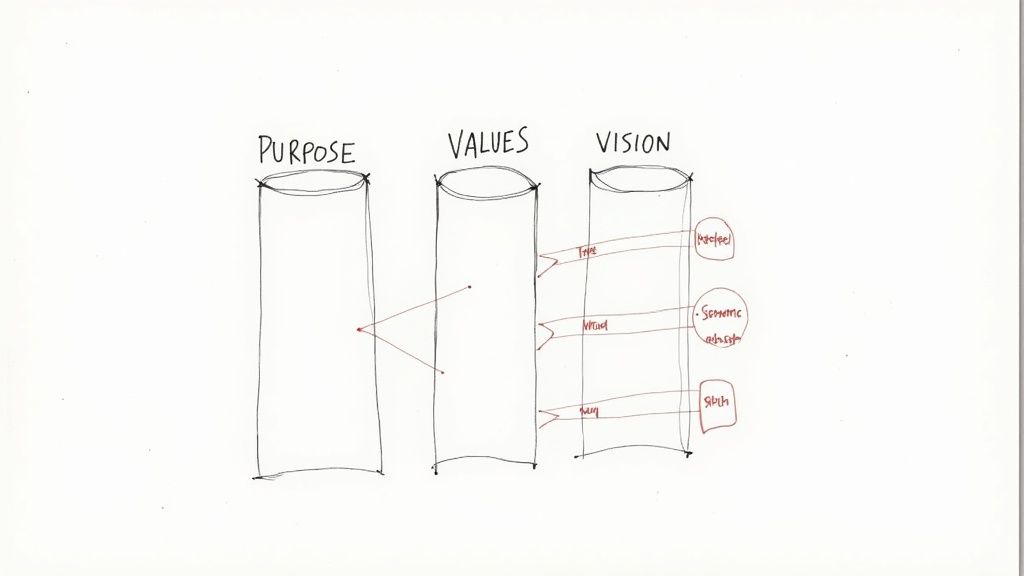
This connection isn’t mystical; it’s a direct translation of strategic pillars into linguistic form. Think of it as a bridge:
Purpose → Tone of voice: A brand with a daring purpose requires a name with a confident, assertive tone. A brand built on serenity needs a name that sounds calm and fluid.
Values → Semantic field: Your core values define the family of words and concepts that feel authentic. A brand valuing precision will gravitate toward words of clarity and logic, not ambiguity.
Vision → Sound pattern: Your long-term vision shapes the name's phonetic architecture. A fast, agile tech tool benefits from a short, sharp name, while a legacy brand might choose a more lyrical, substantial one.
Consider Patagonia, a name that sounds like rugged, purpose-driven endurance. Or Stripe, which signals clean, seamless function. Or Oatly, whose quirky sound embodies the brand’s humor and rebellion. Each is a direct, audible reflection of its strategic core.
Naming is where positioning becomes audible.
Linguistics as Strategy
To translate strategy into a name, you must engage with the architecture of language. This isn't an academic exercise; it's a practical application of how meaning is constructed. Semiotics—the study of signs and symbols—reveals that a name’s power often comes from its form (how it sounds and feels) as much as its content.
Three linguistic dimensions are critical:
Phonetics: The sound of a name carries emotion. Hard "plosive" consonants like P, T, and K feel energetic and precise (Kodak, Stripe). Soft "sibilant" sounds like S and F can suggest smoothness and sophistication (Silk, Sonder).
Morphology: A word's structure implies certain qualities. Short, single-morpheme names like Bolt or Slack feel agile and modern. Compound or multi-syllable names like Microsoft can project credibility and depth.
Conceptual Metaphor: As cognitive linguists George Lakoff and Mark Johnson outlined in Metaphors We Live By, we understand abstract ideas by mapping them onto concrete experiences. This is the secret weapon of great naming.
A brand name is a compact metaphor that instantly transfers a whole set of desired associations onto your brand. Nest has nothing to do with technology; it’s a metaphor for "home," "safety," and "nurturing." It frames a complex product in simple, emotional terms.
A name is a metaphor you can trademark.
How Strategy Becomes Words
Great names aren’t invented; they’re decoded from strategy. The process is a disciplined translation, moving from abstract goals to concrete language. It requires resisting the urge to brainstorm random words and instead following a structured path.
Here is a practical framework for that translation:
Identify the Core Tension: Compelling brands are built on a "productive tension"—a balance between two seemingly opposing forces. Is your brand a mix of technology vs. humanity? Speed vs. safety? Modernity vs. heritage? Pinpointing this tension provides a sharp creative focus.
Define the Linguistic Stance: Next, define your brand’s archetype. Is it the humble guide, the heroic innovator, the playful rebel, or the precise expert? This stance dictates how your brand speaks. Notion embodies the calm intellectual, born from a vocabulary of cognition. Klarna projects clarity and precision through its sharp, clean sound.
Choose Semantic Territories: Translate your stance into specific "semantic territories"—families of concepts that carry the right emotional weight. A "precise expert" might explore territories of light, geometry, or foundational knowledge. This creates a rich, strategically aligned pool of ideas.
Filter for Phonetic Resonance: Finally, filter your ideas for their "mouthfeel." Does the sound align with the brand's persona? This is where strategic logic meets linguistic art. A name must not only mean the right thing; it must feel right when spoken.
This deliberate process ensures every candidate is evaluated on strategic fit, not subjective taste. You move from "I like the sound of it" to "This sound communicates our core value."
Great names aren’t invented. They’re decoded from strategy.
The Psychology of Linguistic Trust
Why do some names instantly feel trustworthy while others feel risky? The answer lies in cognitive science, specifically the principle of cognitive fluency.
Cognitive fluency is the measure of how easily our brains process information. We are wired to prefer things that are easy to think about. When a name is simple to say, read, and remember, it creates a subtle but immediate feeling of comfort and familiarity. As psychologists like Alter and Oppenheimer have shown, this processing ease increases our perception of truth, safety, and likability.
A clear, focused strategy should lead to clear, focused language. That linguistic clarity creates the cognitive ease that builds a foundation of trust. An overly complex, awkward, or misspelled name creates friction, sending a subconscious signal of risk or a lack of clarity. Your name becomes the first piece of evidence that your brand is either straightforward or complicated.
When language feels right, strategy feels real.
This principle is even more critical for brands with global ambitions. A phonetically simple name that works across languages is a massive strategic advantage, breaking down barriers and ensuring your message remains intact. A smart naming brand strategy uses linguistic clarity as a tool to engineer trust from the very first impression. {{cta}}
The Pitfalls of a Disconnected Naming Strategy
Even with the best intentions, the path from strategy to name is littered with traps. Founders who treat naming as a purely creative exercise often fall into the same predictable and costly errors.
| Pitfall / Gotcha | Why It's a Problem | How to Avoid It |
|---|---|---|
| "The Brainstorming Free-for-All" | Generates hundreds of disconnected, trendy, or subjective names that have no strategic anchor. Wastes time and energy. | Start with a tight brief. Define your core tension, linguistic stance, and semantic territories before generating a single name. |
| "Falling in Love Too Early" | Emotional attachment to a name before it has been screened for trademark, domain, and linguistic issues. | Screen early, screen often. Run preliminary trademark and domain checks at every stage. Treat names as candidates, not finalists, until they are vetted. |
| "Designing by Committee" | Trying to find a name that pleases everyone leads to safe, generic, and forgettable results. | Appoint a small, decisive team. Use the strategic brief as the objective scorecard to evaluate names, removing subjective preference from the equation. |
| "Ignoring Global Linguistic Checks" | A name that sounds great in English could be a PR disaster in another language (e.g., negative connotations, profanity). | Conduct linguistic and cultural checks for your key target markets. Don't assume a name travels well. |
Caselet: From Generic to Strategic
A B2B SaaS startup in the logistics space was initially named "LogiFlow." It was descriptive but generic, blending in with dozens of similar-sounding competitors. It was also difficult to trademark.
The Shift: Their core strategy was built on the tension between complex global supply chains (chaos) and their software's ability to provide a single source of truth (clarity).
The Process: Instead of brainstorming more "logi-" words, they explored semantic territories related to clarity, vision, and navigation. This led them to the name "Axial."
The Result: "Axial" was short, memorable, and phonetically strong. It worked as a metaphor for being the central point around which complex systems revolve. It was legally protectable, and the matching
.comwas available. The new name elevated their perception from a simple tool to a strategic platform, contributing to a 40% increase in enterprise lead quality within six months of the rebrand.
Conclusion: When Strategy Speaks
A name is not a label you attach to a finished strategy. It is the strategy's final, audible form. The journey from an abstract idea to a word you can own and defend is a process of strategic synthesis, where positioning, psychology, and linguistics converge.
When you treat naming with this rigor, you elevate the conversation from "Does it sound cool?" to "Does it do the strategic work required?" A name that can answer that question is more than a marketing tool; it is a true business asset.
A strategy that just sits in a deck isn't finished. It only becomes real when it can be spoken.
A strategy that can’t be spoken isn’t finished. The moment you name it—you make it real.
Further Reading
For those who wish to explore the thinking behind this approach, these works provide a rich foundation in the intersection of strategy, language, and cognition:
Metaphors We Live By – George Lakoff & Mark Johnson
The Language Instinct – Steven Pinker
How Brands Grow – Byron Sharp
The Brand Gap – Marty Neumeier
Next Steps Checklist
Draft a One-Page Naming Brief: Before you generate a single name, document your purpose, values, core tension, and linguistic stance. This is your strategic North Star.
Map 3-5 Semantic Territories: Based on your brief, identify distinct conceptual fields to explore. This will guide your creative exploration and keep it strategically grounded.
Run Preliminary Trademark Screens: Use the USPTO's TESS database or a similar tool to run initial checks on your top 5-10 candidates. Don't get attached to a name you can't own. You can learn more about how to avoid trademark infringement in our detailed guide.
Test for Phonetic Resonance: Say your top candidates out loud. Do they feel right? Are they easy to pronounce and remember? Get feedback from a small, trusted group.
Use AI to Expand, Not Decide: Use a tool like Nameworm to rapidly generate ideas within your defined territories, but use your strategic brief as the final judge.
Ready to find a name that's both strategic and protectable? Nameworm uses AI to generate powerful name ideas, grounded in your unique brand strategy. Start building a name you can own and grow with. Explore your options at https://www.nameworm.ai.