The Three Invisible Layers of Naming Strategy: Semantics, Sound, and Story
Go beyond aesthetics with a naming strategy that layers semantics, sound, and story to build a memorable and legally defensible brand.
Most founders approach naming as an aesthetic choice. They hunt for a word that “sounds cool,” feels clever, or polls well on Slack. This is a strategic error. While the surface-level appeal of a name matters, world-class naming strategy happens at three deeper, structural layers that most people never see.
A great name isn't found in a brainstorm; it's engineered. It’s a compressed brand system built on a framework that balances meaning, feeling, and direction. Understanding this framework is the difference between a name that’s a strategic asset and one that’s a long-term liability.
The three invisible layers are:
Semantics: The conceptual territory a name occupies. This is its meaning.
Phonetics: The psychological effect of its sound. This is its feeling.
Narrative: The implied story it tells about the future. This is its direction.
When these three layers align, a name feels potent, memorable, and inevitable. When they don’t, it collapses under its own weight, creating confusion and killing momentum. This framework is how top agencies evaluate candidates—and it’s how you should, too. For founders who want to test their names through these three layers, Chat Nameworm analyzes the semantic vibe, phonetic clarity, and narrative vector before you invest in branding or trademarking.
Layer One: Semantic Field. What the Name Means
The first and most foundational layer is the semantic field: the conceptual territory a name claims in a customer's mind. Before anyone reads your tagline or sees your logo, the name is the first piece of data they receive. Their mind instantly files it away, forming an initial judgment that frames every subsequent interaction. Getting that initial categorization right is mission-critical.
Semantics determines a name’s emotional direction (calm vs. energetic), its metaphorical frame (nature vs. architecture), and its worldview. Choosing this territory is a strategic act, not an aesthetic one.
Consider the semantic fields of these brands:
Stripe: The name belongs to a territory of precision, infrastructure, and linearity. It feels foundational, reliable, and sharp.
Calm: This name operates in a field of serenity, mindfulness, and emotional regulation. Its conceptual space is quiet and centered.
Drift: Here, the semantic territory is movement, ease, and seamless transition—a perfect fit for conversational marketing.
Nest: Drawing from the world of nature, the name instantly evokes safety, home, and warmth.
Ritual: This name positions its products within a frame of daily practice and intention, elevating them from simple commodities.
These choices are deliberate. They anchor the brand in a specific conceptual space, setting clear emotional expectations from the very first touchpoint.
Insight: Semantics decide how the mind categorizes the brand before reading a single tagline.
Layer Two: Phonetic Shape. How the Name Sounds
Before your brain processes what a name means, your subconscious has already decided how it feels. This is the work of the second layer: phonetic shape. The sounds that make up your name—its vowels, consonants, and syllabic rhythm—carry psychological weight that can make a brand feel approachable or authoritative, energetic or calm.
This isn't theory; it’s phonological psychology, a practical tool used by expert namers to engineer a brand’s personality.
Key patterns include:
Soft consonants (L, M, N, R): These smooth, flowing sounds often signal warmth and approachability. Think of Lumen—its soft opening and vowel glow evoke clarity and light.
Plosives (P, B, K, T): These hard, abrupt sounds feel punchy, confident, and energetic. A name like Bolt uses a plosive to pack speed and power into a single syllable.
Open vowels (a, o, u): Vowels that require an open mouth create a feeling of space and scale. Oura uses its circular vowels to feel expansive and ritualistic.
Short syllabic structure: Crisp, one- or two-syllable names often convey modernity and memorability.
Let's analyze a few more examples:
Sonos: The palindromic symmetry of its sounds reinforces balance and minimalism.
Kora: The organic, melodic vowel flow feels earthy and natural.
These phonetic choices are not accidental. They are engineered to deliver a specific feeling that reinforces the brand’s strategic position.
Insight: Phonetics decide how the name feels before your brain processes meaning.
Layer Three: Narrative Vector. Where the Name Leads
The final structural layer is the narrative vector—the implied story a name tells about the future. A merely good name describes what you do now. A great name points to where you and your customers are headed together. This forward-pointing quality gives a name strategic elasticity, allowing the brand to evolve without feeling disconnected.
A name's narrative vector can point toward different futures:
Aspiration: Names like Rise, Beyond, and Horizon sell a future state of achievement.
Identity: Kind, Ritual, and Human signal a worldview, inviting customers to join a community.
Transformation: Shift and Flow promise a process of change or improvement.
Belonging: Tribe and Kin evoke an immediate sense of community and shared purpose.
Modernity: Nova and Prime feel inherently new and forward-looking.
This encoded story is a core strategic component. Consider Notion. It doesn't scream “collaborative docs.” Its narrative vector points toward intellectual exploration and mastery. The name has room to grow because its story is about organized thought itself.
Or look at the Sonos product line. Names like Move, Roam, Beam, and Arc tell a story of sound in motion. When Oura launched its premium ring, they named it Heritage, a narrative vector pointing to lineage and timeless value.
Insight: The narrative vector is what gives a name long-term strategic elasticity.
How Naming Agencies Balance All Three Layers
World-class naming isn't about picking a favorite from a list. It is a disciplined process of balancing meaning, sound, and story simultaneously. A name might have a perfect semantic fit but a harsh phonetic shape that clashes with the brand’s welcoming personality. Or it might have a compelling story but be so abstract that it creates semantic confusion in a global market.
Top naming agencies evaluate candidates through a multi-dimensional lens. The interplay is where a name’s true power is forged:
Semantics choose the emotional territory.
Phonetics deliver the personality.
Story shapes the category positioning and long-term scalability.
This holistic evaluation separates professional strategy from a simple brainstorm. Agencies like Lexicon Branding are masters of phonetic engineering (Sonos, Pentium), while firms like Collins build entire narrative systems (Mailchimp). Others, like Koto, excel at global emotional minimalism, crafting names with semantic clarity that work across cultures. They prove that a winning name requires an obsessive understanding of how these three layers converge.
Insight: Strong names emerge where meaning, sound, and story converge.
Why Most Founders Fail: Focusing on Only One Layer
I've seen countless naming projects go off the rails not because of bad ideas, but because of imbalanced ones. Founders, driven by their own biases, develop tunnel vision and fixate on a single layer, ignoring the others. The result is always a name that feels structurally unsound.
The engineer gravitates toward pure semantics: “It must describe what we do.” Wrong. Dead wrong. This leads to generic, unprotectable names that are strategically invisible. The creative director focuses only on phonetics: “It just sounds so cool!” This creates names that are emotionally empty. And the visionary founder gets lost in the narrative, choosing a name that “feels deep” but is so abstract it means nothing to the market.
These biases lead to predictable failures:
Overly descriptive names that can't be trademarked.
Pretty-sounding but meaningless names that lack strategic value.
Story-rich names that don’t function in global markets.
This imbalance is a recipe for a painful and expensive rebrand down the road.
Insight: Most bad names are unbalanced names.
How to Use This Framework in Your Own Naming Process
Putting this three-layer framework into practice brings structure to a chaotic process. It shifts the evaluation from subjective taste ("I like this name") to strategic analysis ("This name works for these objective reasons").
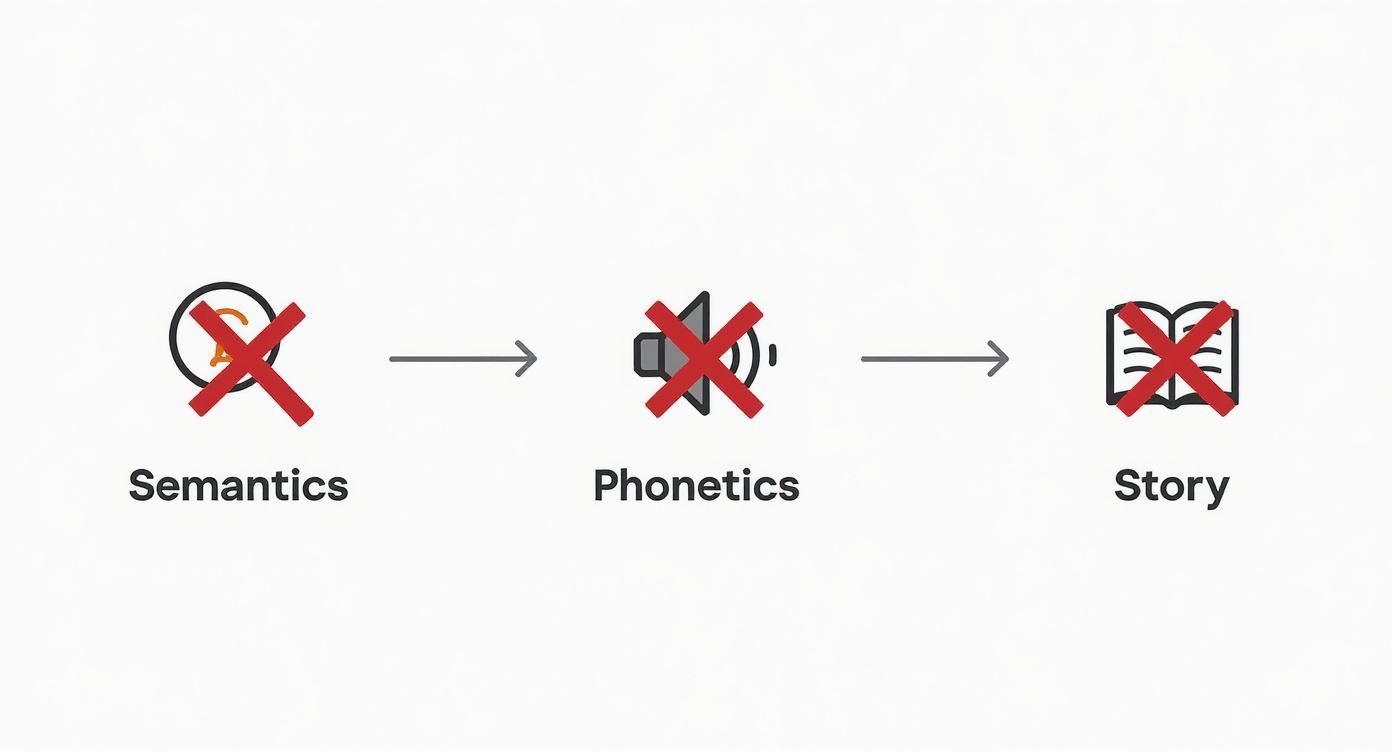
Here is a strategic mini-guide for your process:
Start with emotional intention. Define your semantic territory first. What feeling should your brand own? What conceptual space will it occupy?
Shape the sound to match the brand’s personality. With your semantic direction set, use phonetics to guide creative exploration. Filter ideas for sounds that feel right.
Ensure the name points toward a scalable narrative. Does it open doors for future growth or paint you into a corner?
Then, validate. Only after a name passes these three strategic filters should you move to rigorous checks for linguistic issues, domain availability, and trademark pre-screening.
This structured approach is the only way to build a name that lasts. For founders who want to test their names through these three layers, Nameworm analyzes the semantic vibe, phonetic clarity, emotional direction, and similarity to competitors—before you invest in branding or trademarking.
Conclusion. Naming Strategy Is Meaning Architecture
A brand name is not just a word—it is a compressed brand system. When its semantics, sound, and story align, the result feels inevitable, memorable, and strategically powerful. When they don’t, the name collapses under its own weight, creating friction where there should be momentum.
Great names aren’t discovered. They’re engineered through structure.