What Is Brand Architecture and How Do You Build It?
Confused about what is brand architecture? Learn the core models, naming strategies, and common pitfalls to build a scalable brand that dominates its market.
If your products and services feel like a chaotic mess, you don't have a branding headache—you have an architecture problem.
Brand architecture is the strategic blueprint for how your brands, products, and services relate to one another. It’s the city plan for your business. Get it right, and you eliminate customer confusion, focus your marketing spend, and build a business worth more than the sum of its parts. Get it wrong, and you burn cash on a portfolio no one understands.
This is a core business decision, not a design exercise. Whether you're considering a new product or trying to make sense of your current offerings, a clear architecture is non-negotiable. It's the strategic foundation that precedes any creative work, including naming. For founders ready to build a lasting brand, a powerful naming tool like {{cta}} can accelerate the creative process after you've set this strategic direction.
Key Takeaways
- Strategy First: Brand architecture is a business strategy that dictates how you manage risk, allocate resources, and build equity. It must be decided before naming begins.
- Clarity is Currency: A logical structure makes it simple for customers to understand what you sell and why they should care, guiding marketing, sales, and product development.
- Models Have Trade-offs: The three main models—Branded House, House of Brands, and Hybrid—offer different levels of efficiency, risk, and flexibility. The right choice depends entirely on your business vision.
- Avoid the "Accidental Architecture": Don't let your portfolio grow opportunistically. A lack of planning creates a tangled mess that confuses customers and wastes marketing budget.
Your Brand Is a Blueprint, Not a Billboard
Too many founders treat each new product like a separate billboard, just another thing to shout about. This creates a noisy, disconnected experience for customers trying to figure out what you do.
A strong brand architecture organizes those individual pieces into a coherent system. It’s the framework that answers the tough portfolio questions:
- Does our master brand vouch for every single product?
- Should this new venture carry the family name, or must it stand on its own?
- How do we signal different price points, quality tiers, or audiences across our offerings?
Answering these upfront provides a roadmap for growth. It ensures every new launch makes the entire company stronger, instead of just adding to the noise. This isn't a design task; it's a core business decision that shapes how you go to market, where you invest, and how you build lasting brand equity.
Why Architecture Matters More Than Ever
In a crowded market, clarity is your best currency. A logical structure makes it painfully simple for customers to understand what you sell and why they should care. That clarity then ripples inward, guiding your marketing campaigns, sales pitches, and future product development.
The market is waking up to this. The global Brand Architecture Service market was valued at $1.32 billion in 2021 and is on track to hit $1.84 billion by 2025. Companies are realizing that a clear plan for their brands helps them expand faster and with less risk.
Brand architecture isn't about creating rigid rules. It's about building a flexible system that can handle future growth without falling apart. It’s the difference between a sprawling, chaotic city and a planned, thriving metropolis.
Ultimately, your architecture is a huge piece of your overall brand strategy. It sets the logic for your naming conventions, making sure every name you choose has a specific job to do. Before you even think about brainstorming creative names, you have to build the strategic container they're going to live in.
Choosing Your Brand Architecture Model
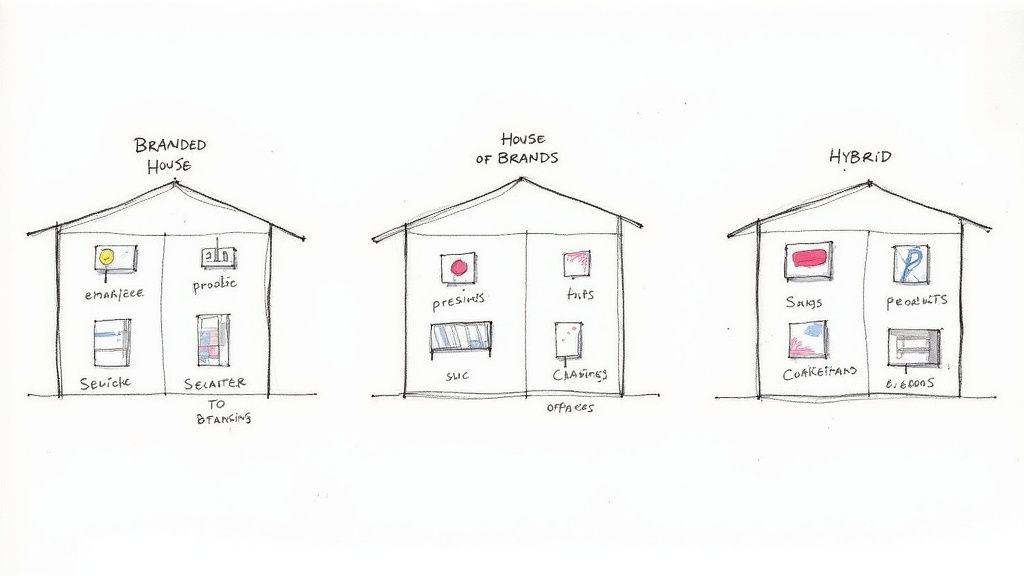
This isn’t a theoretical exercise. Your choice of architecture is a strategic decision with massive impact on your budget, speed, and risk management. This is where you decide how the world will understand your portfolio of offerings. There are three classic frameworks, each with distinct trade-offs. Getting this right can save you from costly rebranding disasters down the road.
The Branded House Model
Simple and efficient. In a Branded House, everything lives under one powerful master brand. Think of a single tree trunk with many branches—everything connects back to the same root system. The master brand is the star, lending its reputation to every new product.
- Real-World Example: Google. You have Google Maps, Google Drive, and Google Calendar. The "Google" name instantly signals trust and function. FedEx is another classic, with FedEx Express, FedEx Ground, and FedEx Freight all leveraging the master brand's equity.
- Best For: Companies with a strong, focused value proposition that applies across all offerings. It’s perfect when your products are thematically linked and aimed at a similar audience.
The big win is marketing efficiency. You promote one brand, and every sub-brand benefits. The flip side? All your eggs are in one basket. A major flop can tarnish the entire brand.
The House of Brands Model
The complete opposite. With the House of Brands model, a parent company owns a portfolio of distinct, standalone brands. Each has its own identity, audience, and marketing strategy. The individual brands are the celebrities; the parent company often stays invisible to the consumer.
- Real-World Example: Procter & Gamble (P&G). Most shoppers know Tide, Pampers, and Gillette, but few know they all belong to P&G. Each brand is free to dominate its specific niche.
- Best For: Companies targeting wildly different market segments where a single brand association would be limiting or confusing.
This model allows for surgical market segmentation and insulates your brands from each other. A crisis with one brand won't sink the others. The downside? It’s expensive. Each brand needs its own dedicated budget and team to build awareness from scratch.
The Hybrid Model
A strategic mix of the two. The Hybrid Model (or Endorsed model) combines elements of both a Branded House and a House of Brands. This often looks like a master brand lending credibility to a diverse set of sub-brands, which still maintain their own unique identities.
- Real-World Example: Microsoft. Flagship products lead with the master brand (Microsoft Azure, Microsoft 365). Acquired brands like LinkedIn keep their identity but get an endorsement ("a Microsoft company"). And Xbox stands as its own powerhouse brand with only a subtle connection.
- Best For: Companies growing through acquisition or diversifying into new markets where the master brand's direct association might not be a perfect fit. It offers a smart balance of leverage and flexibility.
A hybrid structure lets you place strategic bets. You can launch a riskier venture under a new name while still giving it a subtle nod of approval from the established parent brand, minimizing downside while signaling credibility.
Brand Architecture Models at a Glance
Making the right call means weighing the trade-offs between efficiency, flexibility, and risk. This table lays out the core differences.
| Model | Core Strategy | Marketing Efficiency | Risk Profile | Best For |
|---|---|---|---|---|
| Branded House | One brand to rule them all. The master brand provides all the equity. | Very High. Centralized marketing spend builds a single, powerful brand. | High. A failure in one area can damage the entire master brand. | Focused companies with a strong, extendable core promise. |
| House of Brands | A portfolio of independent, standalone brands. | Very Low. Each brand needs its own budget to build awareness and equity. | Low. Brands are insulated; a failure in one doesn't affect others. | Conglomerates targeting diverse markets and customer segments. |
| Hybrid | Master brand endorses a mix of independent and co-branded offerings. | Moderate. Balances centralized efficiencies with targeted spending on sub-brands. | Moderate. Risk is spread out, but a major sub-brand failure can still impact the endorser. | Companies that grow by acquisition or need to enter diverse markets. |
Your brand architecture is a foundational decision. It dictates your naming conventions, marketing structure, and capacity for growth. Choose the blueprint that best serves the company you are today and the one you’re building for tomorrow.
How Brand Architecture Shapes Your Naming Strategy
Think of your brand architecture as the rulebook for every name you'll ever create. The model you choose directly shapes your naming strategy, setting the creative guardrails and the ultimate goal.
A Branded House model demands names that echo and reinforce the master brand. It’s no coincidence we have Apple Pay, Apple Watch, and Apple TV. The formula is brutally simple: Master Brand + Generic Descriptor. This approach piggybacks on existing brand equity. The goal isn't creative flair; it's cohesive clarity.
Conversely, a House of Brands architecture demands distinct, standalone names capable of building their own equity. Procter & Gamble doesn't sell "P&G Diapers"; it sells Pampers. Each name is crafted to own a specific niche, untethered from the corporate mothership.
Aligning Naming with Your Chosen Model
The link between your architecture and your naming is non-negotiable. Get it wrong, and you'll create confusion and burn through your marketing budget.
Here’s a quick framework to make sure your naming serves your architecture:
- For a Branded House: Prioritize descriptive, logical names. Your naming brief should be laser-focused on clarity and consistency. The main creative challenge? Finding simple, intuitive descriptors that aren't already trademarked.
- For a House of Brands: Aim for names that are distinctive, memorable, and legally protectable. The creative brief is wide open, exploring unique personalities for each brand. This requires maximum creative firepower and rigorous trademark screening.
- For a Hybrid Model: This requires the most discipline. You need crystal-clear rules for when a new product gets the master brand's endorsement (like Courtyard by Marriott) versus when it stands on its own (like Marriott's Autograph Collection).
Caselet: From Monolith to Agile Portfolio
Let's look at "SyncUp," a B2B SaaS company known for its rock-solid project management tool. They operated under a strict Branded House model, successfully launching "SyncUp Analytics" and "SyncUp Chat."
Then they decided to build an experimental AI tool for creative teams—a riskier venture for a different user. Launching as "SyncUp AI" would have been a mistake. An experimental product failure could tarnish the core brand's reputation for stability.
The Fix: They shifted to a Hybrid model. They launched the new tool under a separate name: "Muse." This allowed "Muse" to develop its own playful brand, free from SyncUp's corporate image. The only link was a subtle "A SyncUp Company" tagline, offering a quiet endorsement without tying the brands' fates together. This pivot enabled innovation without risking their core brand equity. As a result, Muse attracted 10,000 beta users from the creative community in its first three months, an audience SyncUp could never have reached directly.
Checklist for Naming Cohesion
Before you approve any new name, run it through this architectural filter:
- Role & Relationship: Does this name’s structure clarify its relationship to the master brand?
- Linguistic Harmony: If part of a Branded House, does the name follow the established linguistic pattern (e.g., Apple ____, Google ____)?
- Cross-Portfolio Trademark Risk: Have you screened the name to ensure it doesn't create confusion with another brand you already own? This is a surprisingly common and costly oversight.
- Future Flexibility: Does this naming choice lock you into a pattern that might not work for future products?
Common Brand Architecture Mistakes (and How to Avoid Them)
I hear a myth from early-stage founders: "We're just a startup. We're too small for brand architecture."
Wrong. Dead wrong.
Waiting until you have a chaotic portfolio is like waiting until your house is on fire to buy a smoke detector. Ignoring architecture leads to predictable, expensive mistakes that burn cash and confuse customers.
Pitfall 1: The Accidental Architecture
This is the most frequent mistake. It happens when a company grows opportunistically, bolting on new products without a master plan. Each launch seems logical at the time, but you end up with a tangled mess that’s impossible for customers to navigate. The result is a portfolio that looks like a cluttered garage, diluting your brand’s clarity and every marketing dollar you spend.
How to Avoid It: A Simple Portfolio Audit
Before you launch anything else, map out what you already have.
- List Everything: Open a spreadsheet. List every product, service, feature, and plan.
- Define the Job: For each item, write one sentence: What does it do and who is it for?
- Map Relationships: Group related offerings. Are "Pro" and "Enterprise" genuinely different products, or just pricing tiers of the same core service?
- Identify Overlap & Gaps: Pinpoint where you have redundant offerings causing internal competition or confusion.
- Prune or Integrate: Make the tough calls to consolidate similar products or sunset those that no longer fit the strategy.
This audit gives you a clear "as-is" blueprint and forces you to think strategically about every future addition.
Pitfall 2: The Strategic Straitjacket
The opposite mistake is an architecture that’s too rigid. A founder falls in love with the elegant look of a Branded House, forcing every venture to follow a strict "Master Brand + Descriptor" convention. This works until the company wants to enter a new market or launch a high-risk experiment where the master brand's reputation could be tarnished. The rigid structure that once provided clarity now stifles innovation.
The Fix: Build for flexibility. Unless you are 100% certain your company will only ever play in one narrow field, a Hybrid model often offers the most long-term resilience. It lets you maintain a strong core brand while giving you the freedom to launch standalone or endorsed brands when a strategic opportunity calls for it.
Pitfall 3: The Ego-Driven Sub-brand
This mistake is born from vanity, not strategy. An internal team leader wants their "own" brand to champion, leading to a shiny new sub-brand for a feature that should have been a simple extension of an existing product. These vanity projects are resource vampires. They demand their own marketing budgets, fracture the customer experience, and create a minefield of trademark issues for no strategic gain.
What to Do Instead: The "One Question" Test
Before greenlighting any new sub-brand, ask this question: "Does this offering require a fundamentally different brand promise or target a completely different audience than our existing products?"
- If the answer is no, it's a feature, not a sub-brand. Fold it into your existing structure.
- If the answer is yes, then you have a strategic case for creating a new identity.
This simple test filters out ego and anchors every decision in market reality.
A Simple Framework for Choosing the Right Model
Theory is great, but execution is what matters. To get from understanding the models to choosing one, you need a practical framework. The right architecture is a direct reflection of your business vision, risk tolerance, and go-to-market plan.
While AI tools like Nameworm are powerful for generating name ideas within a defined strategy, the architecture itself demands a founder’s strategic gut check. Your answers to these four questions will point you toward the most logical model.
Four Core Questions to Define Your Architecture
Be brutally honest about your long-term goals.
- What’s your long-term vision? Are you building a deep, specialized solution in one core market? That leans toward a Branded House. Planning to jump into totally different markets with different customers? That screams House of Brands or Hybrid.
- What’s your risk tolerance for new ventures? If you plan to launch experimental products, a House of Brands or Hybrid model acts as a firewall, protecting your main brand. A Branded House puts the master brand's reputation on the line with every launch.
- How centralized is your marketing budget? A Branded House is the most efficient—every dollar promotes one master brand. A House of Brands is the most expensive, requiring a separate budget to build each brand from scratch.
- Does your master brand need to endorse every product? Is the halo effect of your main brand relevant for every new launch? A premium brand launching a budget alternative might find that a close association confuses and alienates both customer bases.
The decision tree below shows how a lack of planning leads to predictable—and painful—pitfalls.
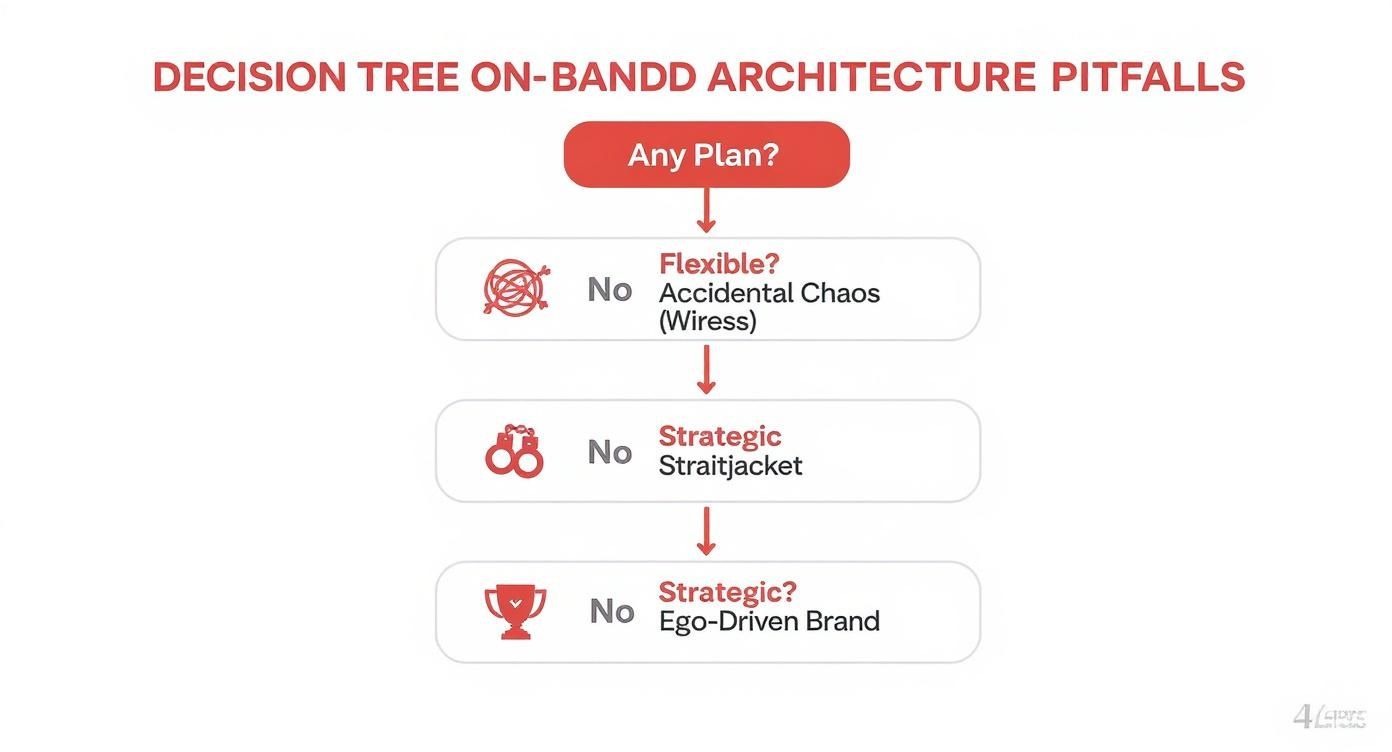
The image drives home a crucial point: your architecture must be a conscious choice. Otherwise, you end up with chaos, rigidity, or decisions driven by ego instead of strategy.
Matching Resources to Your Architectural Needs
Once you have a model, you can decide how to execute the naming.
- Agency: The go-to for complex House of Brands or Hybrid models. They excel at creating distinct brand identities and navigating the thorny trademark landscape of a large portfolio.
- Proven Freelancer: A solid choice for Branded House extensions or the first few launches in a Hybrid setup. You get strategic guidance without the big agency price tag.
- DIY/AI Tool (like Nameworm): The perfect partner once your strategy is defined. Use it to generate hundreds of creative options for a new standalone brand or find descriptive names for your Branded House, all while getting instant domain and trademark checks.
The key is to use the right tool for the right job. An AI tool is your creative engine for generating options after you’ve set the strategic direction. Use it to explore possibilities within the guardrails your architecture provides.
Getting this right has a massive impact. In 2025, Apple is projected to be valued at around $1.3 trillion, partly due to its tight, cohesive Branded House model, which ensures every product reinforces the power of the master brand. It's no accident that over 80% of the cumulative brand value in the Interbrand top 100 is held by fewer than 30 companies—the ones with crystal-clear architectural strategies. You can find more on the link between brand structure and value over at Our Own Brand.
Wrapping Up: Your Next Moves
Your brand architecture is a strategic decision about how to manage risk, allocate resources, and build long-term equity. The model you choose—Branded House, House of Brands, or Hybrid—becomes the rulebook for every future product launch and marketing campaign.
Key Principles to Remember
- Structure Steers Naming: A Branded House needs descriptive, logical names. A House of Brands needs distinct, standalone names. You can't mix and match without causing confusion.
- Plan Before You Plant: The biggest mistake is having no plan. The moment you start thinking about your second product, you need a blueprint.
- Flexibility Is Your Friend: For most growing companies, a Hybrid model offers the perfect balance. It gives you a stable core while leaving room to launch riskier ventures or acquire brands.
Think of your architecture as the foundation of a house. It ensures every addition works together to create something bigger and more valuable than a pile of bricks. Once you've defined your framework, a tool like {{cta}} can be a huge help for generating names that fit perfectly within it.
Next Steps Checklist
- Conduct a Portfolio Audit: Map everything you currently sell. List every product, service, and feature. Identify overlaps, gaps, and sources of confusion to get an honest "as-is" picture.
- Answer the Four Core Questions: Revisit the framework. What’s your long-term vision? Risk tolerance? Budget reality? Need for endorsement? Your answers will point to the right model.
- Draft a One-Page Naming Brief: Based on your chosen architecture, outline the master brand's role and the rules for naming new products. This simple document will keep every future naming project on track and strategically sound.
A Few Lingering Questions on Brand Architecture
Founders usually have a couple of nagging questions about timing, maintenance, and changing their minds. Here are the answers we give most often.
When Should a Startup Bother With Brand Architecture?
The second you start planning your second product. Not after you launch it—the moment the idea for a second offering hits the whiteboard. Thinking about your architecture this early is the best way to avoid the "Accidental Architecture" trap. It’s a five-minute strategic conversation that can save you months of painful cleanup.
How Often Should We Revisit Our Brand Architecture?
Review it annually, but only consider a major overhaul when your business fundamentally changes. A yearly review is a light touchpoint to ensure your structure still makes sense. Save the deep, structural changes for the big moments: a major strategic pivot, a merger or acquisition, or a massive expansion that redefines your core business.
Can We Just Change Our Brand Architecture Later On?
Yes, but it's a beast. It's expensive, complex, and risks confusing customers who have learned how your brands fit together. A change often means rebranding products, redoing marketing materials, and re-educating your audience. It's far better to pick a flexible model, like a Hybrid architecture, from the get-go.
That said, sometimes a change is unavoidable—and brilliant. Google’s move to Alphabet is the textbook example.
The change wasn’t a whim; it was a strategic necessity. Google needed a way to manage a wildly diverse portfolio. By restructuring to a Hybrid model, they ring-fenced the core search and advertising brand, protecting it while allowing ambitious ventures like Waymo to operate on their own. This move insulated the main brand from risk and gave investors a much clearer picture.
While possible, a change on that scale is a massive undertaking. The smartest move is to build for flexibility from day one.
Ready to build your brand on a solid foundation? Once you've defined your architecture, Nameworm provides the tools to generate powerful, strategically-aligned names. Explore unique, protectable names at https://www.nameworm.ai.